
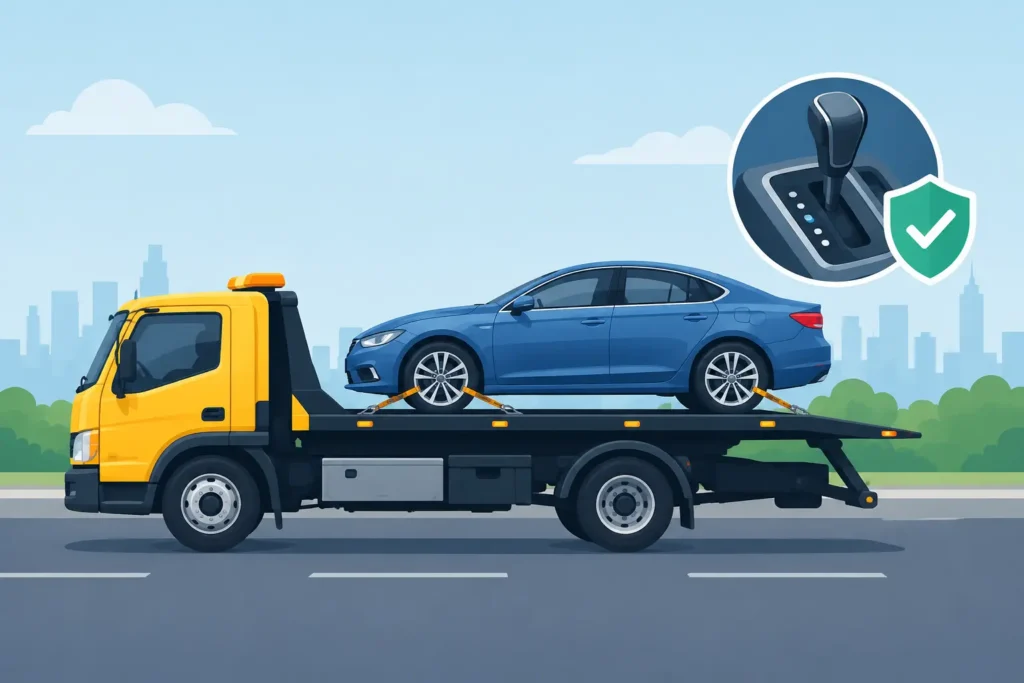
Your automatic car has stopped, you are stuck at the roadside, and the obvious question is whether it can simply be towed away. Can recovery lorries tow automatics? Yes, but only when the recovery method suits the vehicle. Getting this wrong can cause expensive damage to the gearbox, drivetrain or electric motor, so it is never a job for guesswork.
For most automatic cars, a professional recovery vehicle can safely move it. The key is how it is loaded, which wheels are lifted and whether the vehicle has two-wheel drive, four-wheel drive, a hybrid system or an electric motor. A careful operator will ask the right questions before attending and choose the safest option for your car.
Why automatic vehicles need extra care
A manual car can often be towed with its driven wheels on the road and the gearbox in neutral, although it is still not always the best option. An automatic gearbox works differently. Many automatic transmissions rely on an oil pump that is driven by the engine. When the engine is off, that pump may not circulate fluid properly.
If the driven wheels turn while the engine is off, internal gearbox parts can move without the lubrication they need. Over even a short distance, this can lead to overheating and transmission damage. The resulting repair bill can be far worse than the original breakdown.
This is why the old approach of attaching a rope or bar and towing a broken-down automatic behind another vehicle is risky. It may be permitted only for a very short distance in certain emergencies, and only if the manufacturer says it is safe. It should not be treated as a recovery plan.
Can recovery trucks tow automatics on a wheel lift?
They can, provided the correct wheels are off the ground. For a front-wheel-drive automatic, a recovery vehicle may lift the front wheels so they do not rotate on the road. For a rear-wheel-drive automatic, the rear wheels usually need to be lifted instead.
The recovery operator must also secure the vehicle correctly and take account of ground clearance, steering lock position and any damage from the breakdown or incident. In some cases, a towing dolly can support the remaining wheels. This prevents the wrong part of the drivetrain from turning during transport.
However, wheel-lift recovery is not suitable for every automatic. It can be a practical option for a short local journey where the vehicle layout is clear and the car can be safely positioned. If there is any uncertainty, a transport bed is usually the safer choice.
Why a flatbed is often the safest choice
A flatbed recovery vehicle carries all four wheels off the road. The car is winched or driven carefully onto the bed, then secured for transport. Nothing in the drivetrain needs to rotate while the vehicle is being moved.
For an automatic, this removes most of the risk associated with conventional towing. It is particularly useful when the gearbox has failed, the car cannot be put into neutral, the steering is locked, or there has been accident damage. It is also often the preferred option for prestige vehicles, low cars and vehicles with complicated drivetrain systems.
A flatbed can take a little longer to load than a basic tow, especially on a narrow road or busy route, but the extra care is worthwhile. When your car is already off the road, avoiding further damage matters more than saving a few minutes.
Four-wheel drive, hybrids and EVs need the right recovery method
Four-wheel-drive and all-wheel-drive automatics need particular attention. Because power can be sent to all four wheels, lifting only one end may cause drivetrain damage. Many of these vehicles should be carried with all four wheels off the road, unless the manufacturer specifically allows another method.
Hybrid and electric vehicles also require specialist consideration. Some have motors connected directly to the wheels, while others can generate electricity when their wheels turn. Towing them incorrectly can damage electrical components or create a safety risk.
There is no single rule that covers every make and model. A recovery operator should check the vehicle type, listen to what has happened and follow the manufacturer guidance where necessary. If your vehicle is a hybrid, EV, four-wheel drive or has an automatic gearbox with a known fault, say so when you call.
What to tell the recovery operator
Clear information helps the right recovery vehicle arrive first time. You do not need to know mechanical details, but it is useful to provide the make, model, registration and whether the car is automatic, hybrid, electric, front-wheel drive or four-wheel drive if you know it.
Explain what happened before the vehicle stopped. For example, did you hear a bang, see a warning light, lose drive, suffer a puncture, have an accident or find that the car will not select a gear? Also mention whether the wheels turn, whether the steering moves and whether the car is parked in a tight space, underground car park or on a busy roadside.
If you have the owner’s handbook available, do not try to search through it while exposed to traffic. Get yourself somewhere safe first. The recovery team can assess the vehicle on arrival and decide whether a wheel lift, dolly or flatbed is appropriate.
Do not force an automatic into neutral
Drivers are often understandably keen to help when their car is blocking a road, driveway or car park. But forcing the selector, overriding the parking lock without guidance or repeatedly trying to start a failed vehicle can make matters worse.
Some automatics have an emergency neutral release, but its location and operation vary widely. It may need a specific procedure, a key position or a functioning battery. On some modern cars, especially EVs and hybrids, moving the vehicle incorrectly can trigger further faults.
If it is safe, apply the handbrake, switch on your hazard warning lights and wait for professional help. If you are on a motorway or high-speed road, move behind a safety barrier where possible and follow the instructions of the emergency services or road operator. Your safety comes before the vehicle.
Is towing an automatic ever acceptable?
A short tow may be possible in limited circumstances, but it depends entirely on the vehicle manufacturer’s instructions. Some automatic models permit slow towing for a restricted distance with the engine running and gearbox in neutral. Others must not be towed with any wheels on the ground at all.
That distinction is why broad advice found online can be misleading. Two similar-looking automatic cars can have very different requirements. A traditional torque-converter automatic, dual-clutch gearbox, CVT, hybrid and electric vehicle should not be assumed to behave the same way.
For a local breakdown, professional recovery is the sensible option. An experienced operator can protect the vehicle while getting you, your passengers and your car to your chosen destination. Breakdown Recovery Essex provides 24-hour recovery for cars, vans and light commercial vehicles across Chelmsford and the surrounding area, with safe transport arranged around the vehicle in front of us.
A safer outcome starts with the right call
Automatic cars can be recovered safely, but they should not be treated like every other broken-down vehicle. The recovery method needs to match the drivetrain, the fault and the location. When you call, tell the operator that your vehicle is automatic and describe the problem as clearly as you can. That one detail can help ensure the right equipment is sent and your car reaches its destination without adding gearbox damage to an already difficult day.