
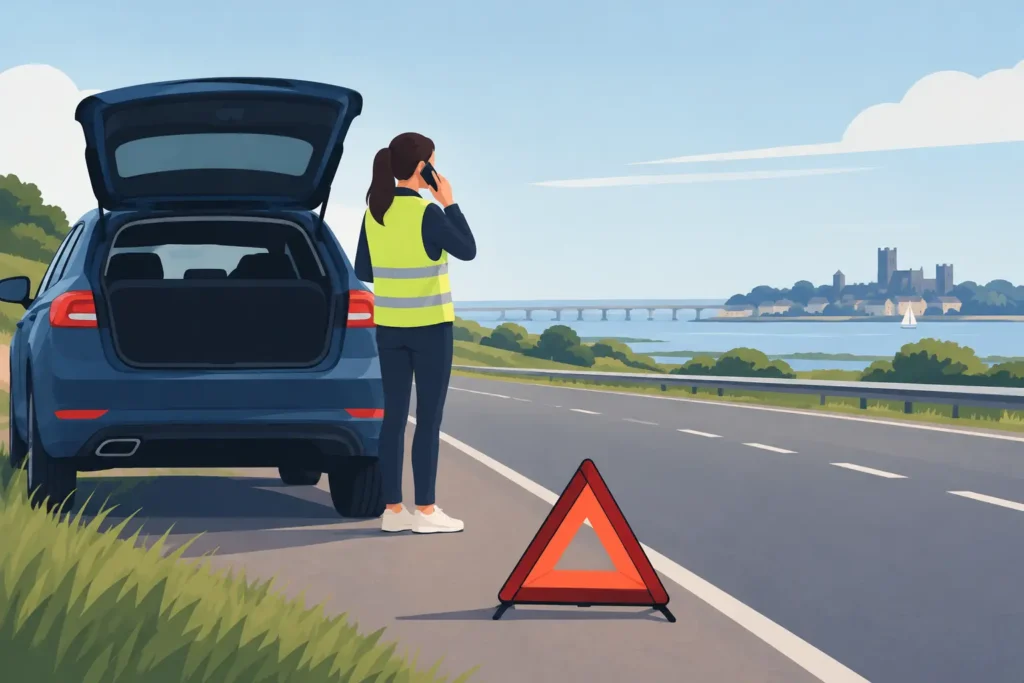
A breakdown can turn a normal journey into a stressful situation in seconds. Whether your car loses power on the A12, a van develops a fault between jobs, or you find a flat tyre on a quiet Essex road, knowing how to stay safe after a breakdown gives you a clear plan when you need one most.
Your first priority is not diagnosing the fault or getting moving again. It is getting yourself, your passengers and other road users out of immediate danger. Once everyone is safe, a professional recovery operator can deal with the vehicle.
How to stay safe after a breakdown: the first five minutes
If you notice a warning light, unusual noise, smoke, loss of power or a flat tyre, stay calm and focus on finding the safest available place to stop. Avoid sudden braking or sharp steering. Put your hazard warning lights on when necessary to warn traffic behind you, then indicate and move to the left as soon as it is safe.
A car park, lay-by, quiet side road or filling station is usually far safer than stopping on a busy carriageway. If the vehicle is still moving, use its remaining momentum carefully to reach a safer position. Do not keep driving if you suspect a serious mechanical problem, particularly if the engine is overheating, there is smoke, you smell fuel, or the steering or brakes feel unsafe.
Once stopped, apply the handbrake, select park or neutral as appropriate, and switch on your hazard warning lights. At night or in poor weather, use sidelights if they help other drivers see your vehicle, provided it is safe to do so and the battery has not failed completely.
If you are on an ordinary road and can leave the vehicle safely, move away from traffic and stand well clear of the carriageway. Do not stand in front of or behind the vehicle, particularly on a bend, near a junction or where visibility is poor.
Choose safety over a quick roadside fix
It is tempting to lift the bonnet, look for a loose connection or change a wheel straight away. That can be reasonable in a safe, well-lit location away from moving traffic. It is not worth the risk on a fast road, narrow lane or busy commuter route.
Never attempt a repair where you could be struck by passing traffic. Avoid working on the side facing the road, and do not crawl underneath a vehicle at the roadside. If you have a puncture but the wheel is on the traffic side, recovery is often the safer option.
Be especially cautious around smoke, steam or fuel smells. Steam may mean an overheating engine, while fuel can create a fire risk. Switch off the engine, keep people away from the vehicle and do not smoke or use a naked flame. Do not remove a radiator cap from an overheated engine – hot coolant can cause serious burns.
If you have had a collision, assess whether anyone is injured. Call 999 immediately if there is a serious injury, a vehicle is blocking a dangerous part of the road, there is fire, or you believe there is an immediate risk to life.
Breaking down on a motorway or smart motorway
Motorway breakdowns need extra care because traffic is moving at speed. If you can, leave at the next junction or pull into a designated emergency area. These areas are designed to provide more protection than a hard shoulder or live traffic lane.
If you have to stop on the hard shoulder, pull as far left as possible, keep your wheels turned slightly left, and use your hazard warning lights. Leave the vehicle by the left-hand doors if it is safe to do so. Move behind the barrier and well away from the vehicle, taking passengers with you. Keep children close and do not allow anyone to wait near the edge of the road.
On a smart motorway, do not stop in a live lane unless the vehicle cannot be moved any further. If you are unable to reach an emergency area or exit safely, put on your hazards, stay as far left as possible and contact emergency services. If it is unsafe to leave the vehicle because of fast traffic, remain inside with seatbelts on and call 999.
Do not place a warning triangle on a motorway. Walking back along the carriageway creates a serious risk. On other roads, a warning triangle may help in some circumstances, but only use one if you can place it safely and well away from traffic. Your own safety comes before any warning device.
Make the recovery call easier
Once you are in a safe place, contact your breakdown provider or local recovery service. The more accurate your location, the quicker the right help can be sent.
Give the operator the road name or number, your direction of travel, the nearest village, junction, landmark or postcode, and details of where the vehicle is positioned. On a motorway, look for the nearest marker post or emergency phone location. Tell them the vehicle make, model, registration and whether it is a car, van or light commercial vehicle. Mention if you have passengers, children, pets, a trailer, a flat tyre, or any issue that may affect safe loading.
Be clear about what has happened, but do not worry if you cannot identify the fault. A simple description such as “the engine cut out”, “the vehicle will not start” or “there is a warning light and smoke” is enough to help the recovery operator prepare.
If you need recovery in or around Chelmsford, Breakdown Recovery Essex can arrange professional assistance day or night and transport your vehicle to your chosen destination. While you wait, keep your mobile phone charged where possible and listen for updates about the estimated arrival time.
Wait safely without making yourself a target
A stranded vehicle can leave you feeling exposed, particularly after dark or in an unfamiliar area. If you are stopped somewhere safe, keep the doors locked and only lower a window enough to speak to someone if you are unsure who they are.
A genuine recovery operator should know your name, vehicle details and the job they have been sent to attend. If somebody offers help but you are uncomfortable, stay inside the locked vehicle if that is the safer choice, call your recovery provider and ask them to confirm who is attending. Trust your judgement.
If you must wait outside, choose a position away from traffic and where you are visible to the recovery driver without standing in danger. Wear a high-visibility jacket if you have one, especially at night, in rain or on rural roads. Keep warm with spare clothing or a blanket, but do not run the engine in an enclosed space such as a garage because of exhaust fumes.
For parents and carers, the safest approach depends on the road. On a quiet, safe location, keep children with you and away from the carriageway. On a motorway hard shoulder, get everyone behind the barrier if it is safe to exit on the left. Never allow children or pets to wander while you make calls or inspect the vehicle.
What to keep in your vehicle
You do not need a boot full of equipment, but a few basics make an unexpected stop less difficult. Keep a charged mobile phone or power bank, torch, high-visibility jackets, warm layers, drinking water and a first-aid kit. A tyre inflator, locking wheel nut key and correctly sized spare wheel can be useful, but only use them where the location is safe.
It also helps to keep your recovery contact details saved in your mobile phone rather than searching for them under pressure. Before longer journeys, check fuel level, tyre condition, coolant, oil and battery health. These checks cannot prevent every fault, but they reduce the chance of being stranded for a simple reason.
Let the recovery team take it from there
When help arrives, follow the operator’s instructions and tell them about any warning lights, leaks, damage or failed attempts to start the vehicle. Remove valuables, medication, work equipment and anything you will need before the vehicle is loaded. Check that you know where the vehicle is being taken and how you will get home or continue your journey.
A breakdown is inconvenient, but it does not have to become dangerous. Put distance between yourself and moving traffic, share an accurate location, and resist the urge to solve a problem at the roadside when conditions are not safe. A calm decision in the first few minutes is often the one that matters most.