
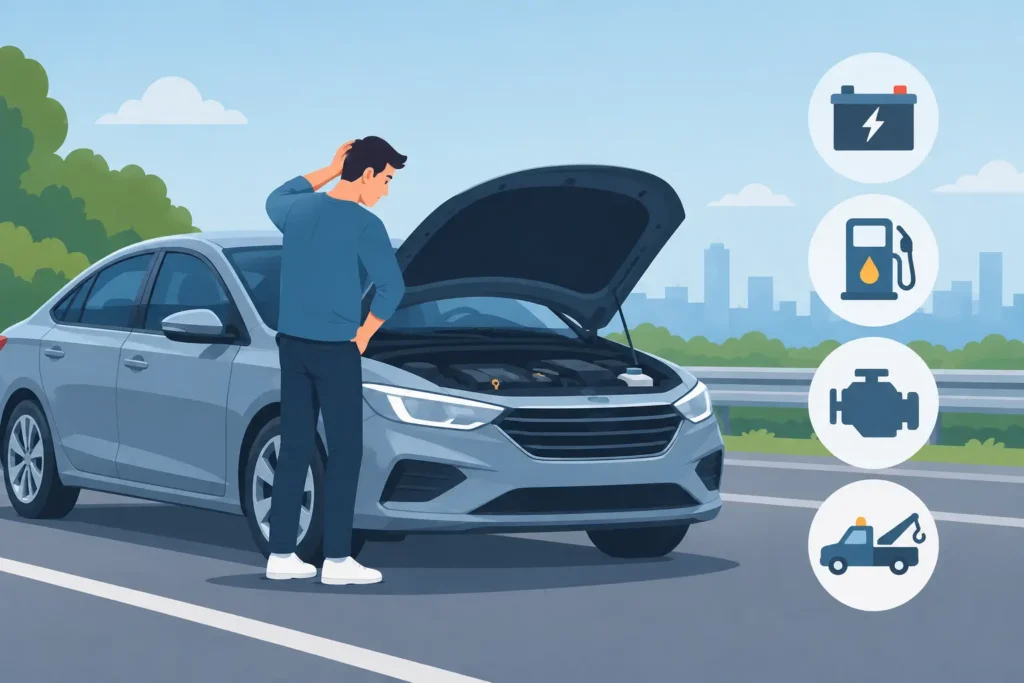
A car that cuts out at a roundabout, in slow-moving traffic or while joining a faster road can turn a normal journey into a stressful situation within seconds. Cars stall unexpectedly for many reasons, from a minor sensor fault to a fuel or electrical problem, and the right response depends first on where you have come to a stop.
Your priority is not diagnosing the car at the roadside. It is getting yourself, your passengers and other road users out of danger. Once you are safe, you can decide whether the vehicle is likely to restart, needs a simple check, or requires professional recovery.
What to do when your car stalls unexpectedly
If the engine has stopped but the car is still rolling, steer calmly towards a safe place away from moving traffic. Use your hazard warning lights when appropriate and avoid harsh braking. Remember that the steering may feel heavier and the brake pedal may take more effort once the engine is off, particularly in older vehicles.
If you are already stationary, put the handbrake on, select neutral or park, and switch on the hazard lights. Try to stop somewhere visible and away from bends, junctions and live lanes where possible. On a motorway or dual carriageway, do not attempt repairs beside traffic. Move behind a safety barrier if it is safe to do so, keep well clear of the vehicle, and seek help.
On a quieter Essex road, it can be tempting to lift the bonnet immediately. That may be reasonable only if you are safely off the carriageway, the engine has cooled where necessary, and there is an obvious simple issue to check. Never stand in traffic or put yourself at risk to get the car going again.
If the car restarts, do not assume the problem has disappeared. A brief stall can be a warning that returns at the next junction or under load. Drive only as far as you can safely manage, preferably to a secure location or garage, and arrange recovery if the fault continues.
Why do cars stall unexpectedly?
A stall means the engine has stopped running when it should have continued. In a manual car, this can happen because the clutch has been released too quickly at low speed. But when an experienced driver notices repeated stalling, or an automatic vehicle cuts out, there is usually another issue worth investigating.
Fuel supply problems
The engine needs a steady supply of clean fuel at the correct pressure. A failing fuel pump, blocked fuel filter or contaminated fuel can interrupt that supply and cause hesitation, loss of power or a complete stall. The problem may be more noticeable when accelerating, travelling uphill or when the fuel level is low.
An inaccurate fuel gauge can also catch drivers out. If the car has run out of fuel, do not repeatedly crank the engine. Some diesel systems can be difficult to restart after running dry and may need priming. Put safety first and get the right assistance rather than risking damage to the system or flattening the battery.
Battery, alternator and wiring faults
Modern cars rely heavily on electrical power. The battery starts the engine, while the alternator keeps it charged when you are driving. If the alternator is failing, warning lights may appear, the headlights may dim, electrical equipment may behave oddly, and eventually the engine can stop.
A loose battery connection, damaged earth lead or corroded terminal can create similar symptoms. A car may start after a jump-start but then stall again shortly afterwards if it is not charging properly. That is a strong reason not to keep driving and hope for the best.
Air intake and sensor issues
The engine management system constantly adjusts the fuel and air mixture. Sensors help it understand engine speed, airflow, temperature and throttle position. When one of these sensors fails or sends incorrect readings, the engine may idle roughly, cut out at low speed or struggle to restart.
A dirty throttle body or blocked air filter can also affect idle speed. These faults often require a diagnostic check rather than guesswork. Replacing parts without identifying the cause can become expensive and still leave you with an unreliable car.
Spark, ignition and engine faults
Petrol engines need a reliable spark to run smoothly. Worn spark plugs, failing ignition coils or damaged leads can cause misfiring before a stall. You may notice shaking, poor acceleration or an engine warning light in the days beforehand.
More serious mechanical problems can also cause stalling, including overheating, timing faults or low oil pressure. If a red warning light appears, the temperature gauge is high, there is smoke, or you hear knocking or harsh metallic noises, switch off as soon as it is safe. Do not restart the engine until it has been checked.
Manual gearbox and clutch problems
Stalling while pulling away is not always an engine fault. A worn clutch, incorrect idle speed or a change in driving conditions can make a manual vehicle easier to stall. However, repeated stalls combined with a burning smell, difficulty selecting gears or a clutch pedal that feels different should be investigated.
Automatic cars can stall too. A fault with the transmission, torque converter or engine idle control may be involved, so an automatic that repeatedly cuts out needs professional attention rather than repeated attempts to continue the journey.
Warning signs worth acting on
Cars rarely fail without any hint at all, although the signs can be easy to dismiss during a busy week. A rough idle at traffic lights, delayed starting, intermittent warning lights, a loss of power or a smell of fuel are all worth taking seriously.
Pay attention if the problem happens in a pattern. Does the car cut out only when it is hot? Does it struggle after rain? Does it stall when slowing down but restart straight away? These details can help a garage identify the fault, and they are useful to tell a recovery operator when you call.
Do not ignore a warning light simply because the car still drives. An amber engine management light may allow you to reach a safe place cautiously, depending on how the vehicle is behaving. A flashing engine warning light, red oil light, red temperature warning or obvious smoke calls for an immediate stop when it is safe to do so.
Can you restart the car safely?
A single restart attempt may be reasonable if you are in a safe location, there are no serious warning signs and the engine simply stalled during a low-speed manoeuvre. Put the vehicle in neutral or park, apply the handbrake and follow the normal starting procedure. If it starts and runs smoothly, move to a safer place before deciding what to do next.
Avoid repeated attempts if the engine turns over slowly, clicks, smells strongly of fuel, cranks without starting, or stops again within seconds. Continual cranking can drain the battery, while restarting an overheated or mechanically damaged engine can make the original fault worse.
Never open a radiator cap on a hot engine. Do not touch exposed wiring, and do not rely on a jump-start if you suspect the car has a charging fault. A jump-start may get the engine running briefly, but it will not repair a failing alternator or loose connection.
When recovery is the sensible option
Recovery is usually the safest choice if your car has stalled in an unsafe location, will not restart, has warning lights or overheating, or cannot be trusted to complete the journey. It is also sensible if you are carrying children, travelling late at night, or driving a van loaded with tools or stock. The cost and disruption of recovery are often far less than the risk of breaking down again in a worse place.
When you call for help, have your location, vehicle registration, make and model, and a clear description of the symptoms ready. Mention whether the car is accessible, whether it is in a car park, driveway or roadside location, and where you would like it taken. This helps ensure the right recovery vehicle is sent and avoids delays.
Breakdown Recovery Essex provides 24-hour vehicle recovery from Chelmsford across the surrounding area, with your car, van or light commercial vehicle taken to your chosen destination. If practical roadside assistance will not solve the problem safely, a careful recovery gives you a clear next step without leaving the vehicle stranded.
A stalled car is unsettling, but you do not need to solve the fault alone at the roadside. Get to a safe place, resist the urge to keep forcing a restart, and arrange dependable help when the vehicle is not safe to drive.