
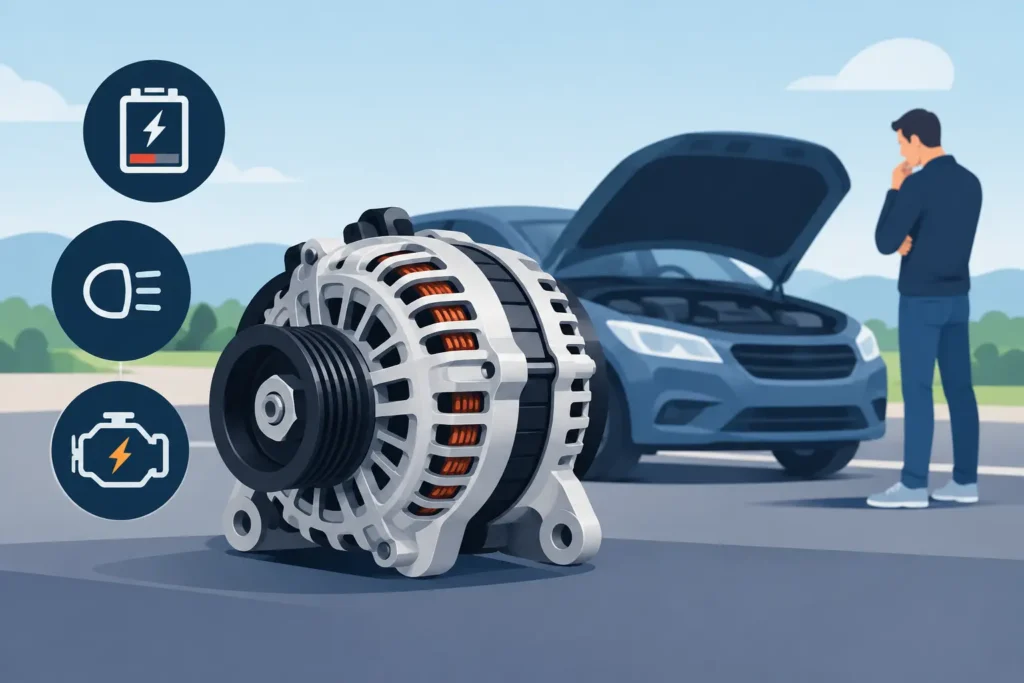
A red battery warning light on the dashboard does not always mean the battery itself has failed. Often, it means the battery is no longer being charged while you drive. Knowing how to identify alternator failure early can be the difference between getting home safely and being left at the roadside, in a car park or outside a customer’s address with a vehicle that will not restart.
The alternator supplies electrical power while the engine is running and recharges the battery after starting. When it starts to fail, the warning signs can be easy to miss at first. A dim headlamp, an occasional warning light or a slow electric window may not feel urgent, but they can quickly lead to a complete breakdown.
What an alternator failure looks like
Your vehicle’s battery provides the initial power to start the engine. Once the engine is running, the alternator takes over the job of supplying electricity for the lights, heating fan, wipers, radio, charging ports and other systems, while also topping up the battery.
If the alternator is weak or has stopped working, the car will run on the remaining charge in the battery. How long it keeps going depends on the vehicle, the battery condition and how much electrical equipment is switched on. It could be a short journey, or it could be only a few minutes.
The most obvious sign is the battery-shaped warning light. Treat this seriously if it stays on while the engine is running, especially if it appears alongside dim lights or unusual electrical behaviour. It is generally safer to assume there is a charging problem rather than hoping the light will go away.
The battery warning light stays on
The battery light should come on briefly when you turn the ignition on, then go out once the engine has started. If it remains illuminated, comes on while driving or flickers over bumps, the charging system needs checking.
There are other possible causes, including a loose connection, a worn drive belt or a battery fault. But alternator trouble is a common reason, and continuing to drive can leave you stranded once the battery charge runs out.
Headlights and interior lights become dim or bright
Lights that fade at idle and brighten when you rev the engine can point to an inconsistent electrical supply. You may also notice the dashboard backlighting looking duller than usual, or cabin lights changing brightness.
This sign is easier to spot in the evening, but do not wait for darkness to take action. If you have a warning light and electrical problems together, make arrangements to stop somewhere safe and have the vehicle assessed.
Electrical equipment starts acting strangely
A failing alternator can cause problems with systems that normally work without a second thought. The blower motor may slow down, the radio may cut out, the electric power steering warning may appear, or electric windows may move more slowly.
Modern cars rely heavily on stable voltage. As voltage drops, warning lights can appear for systems that are not themselves faulty. Do not assume every dashboard warning means a separate major problem. A charging fault can create a confusing collection of alerts.
The engine struggles, cuts out or will not restart
An alternator problem can look like a flat battery at first. The engine may crank slowly, click when you turn the key or fail to start after you have stopped for fuel, shopping or a delivery.
If the car starts with a jump but then loses power again soon afterwards, that is a strong clue that the battery is not being recharged. A jump start may get the engine running temporarily, but it does not repair the underlying charging fault.
You hear a squeal, whine or grinding noise
Some alternator faults make noise before they cause a complete breakdown. A high-pitched squeal may come from a slipping or worn auxiliary belt. A whine or grinding sound from the engine bay can be linked to worn alternator bearings.
Noise alone does not prove the alternator has failed, as belts and pulleys can cause similar symptoms. However, it should not be ignored, particularly when combined with a battery light or flickering lamps.
How to identify alternator failure without making it worse
There is no need to dismantle anything at the roadside. Focus on the pattern of symptoms and on getting yourself, your passengers and the vehicle somewhere safe.
If the battery warning light comes on while driving, reduce electrical demand where it is safe to do so. Switch off non-essential items such as heated seats, the rear screen heater, charging leads and the radio. Keep essential lights on whenever conditions require them. Never turn off headlights at night, in poor weather or where visibility is reduced just to save battery power.
Avoid repeatedly trying to restart the engine. Each attempt drains the battery further, and you may use up the remaining charge needed to move the vehicle to a safer position. If you are already parked safely and the engine will not start, do not keep cranking it.
A basic voltage test can help if you have a multimeter and know how to use it safely. With the engine off, a healthy fully charged 12-volt battery often reads around 12.6 volts. With the engine running, the reading should normally rise to roughly 13.7 to 14.7 volts. A reading that stays close to battery voltage, or falls as the engine runs, suggests the charging system is not doing its job.
That test is useful, but it is not a complete diagnosis. Wiring faults, battery condition, belt problems and voltage regulator faults can all affect the result. A garage can test the battery and charging system properly before parts are replaced.
What to do if the alternator fails while driving
Your priority is not getting every last mile from the car. It is stopping in a safe place before the engine loses power completely.
Look for a safe, legal place to pull in, such as a lay-by, petrol station, car park or quiet side road. Use your indicators early and avoid switching the engine off until you are safely positioned, unless there is an immediate safety reason to do so. Once stopped, put the hazard warning lights on if appropriate and assess the situation.
If you break down on a motorway, follow motorway safety guidance. Where possible, leave at the next exit or reach a place of relative safety. If you cannot do that, stop as far left as you can in an emergency area or hard shoulder where available, leave the vehicle by the left-hand doors if it is safe, and stand behind a barrier. Do not attempt roadside repairs in a live traffic area.
For a vehicle that has lost power on an ordinary Essex road, move as far from passing traffic as possible. Keep passengers away from the carriageway, especially on fast rural routes or in poor visibility. If you feel unsafe, contact the emergency services.
Can you drive with a faulty alternator?
Sometimes a vehicle will continue for a short distance, but it is not a reliable or sensible plan. The engine can cut out when the battery charge is exhausted, and that may affect power steering assistance, lighting and other safety-related systems.
The sensible answer depends on where you are. If you are moments from a safe parking place and the vehicle is still operating normally, you may be able to get there carefully. If the battery light is on, lights are fading or several warnings are appearing, arrange recovery rather than attempting a longer trip. This is especially true for van drivers carrying tools, stock or time-sensitive deliveries: an unplanned stop in traffic usually costs more than a safe recovery.
Alternator fault or battery fault?
The symptoms overlap, which is why drivers often replace a battery only to find the problem returns. A failing battery usually shows itself when starting: the engine turns slowly after the vehicle has been parked, particularly on cold mornings. Once the engine is running, it may be fine if the alternator is charging correctly.
An alternator fault is more likely when the battery warning light appears during a journey and electrical systems begin failing while the engine is still running. A loose or damaged belt can create similar symptoms because the alternator may not be turning as it should.
Battery age matters too. Many batteries last several years, but short journeys, cold weather and frequent use of electrical accessories can shorten their life. The best route is a proper charging-system check rather than guessing from one symptom.
Preventing an inconvenient breakdown
You cannot prevent every alternator failure, but routine checks reduce the chance of being caught out. Pay attention to warning lights, have unusual belt noises inspected and do not ignore recurring starting problems. If your headlights have been dimming or the battery has gone flat more than once, book a check before a longer journey.
For local drivers, fast action matters. Breakdown Recovery Essex can safely recover cars, vans and light commercial vehicles across Chelmsford and the surrounding area when a charging fault leaves you unable to continue. Recovery to your chosen garage is often the safest option when an alternator problem is suspected.
A battery light is your vehicle asking for attention before it runs out of options. Take it seriously, stop safely and get the fault checked while it is still a repair issue rather than a roadside emergency.