
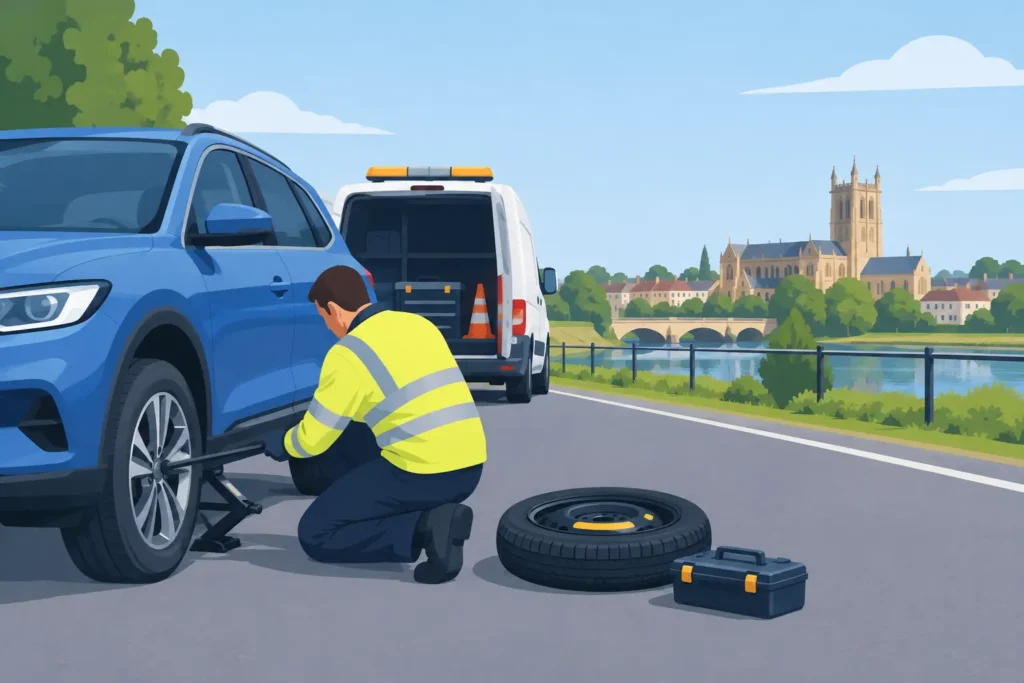
A flat tyre rarely happens at a convenient time. It might be outside your home before work, on a dark country road after a long shift, or while your van is loaded for the day. Flat tyre roadside assistance gives you a safe, practical next step when changing the wheel yourself is not possible, not safe, or simply not the right option.
For drivers across Chelmsford and the surrounding Essex area, the priority is not just getting moving again. It is protecting yourself, your passengers and your vehicle from further damage while arranging the right help.
What to do when you realise you have a flat tyre
Do not keep driving in the hope that the tyre will hold for another mile. A tyre that has lost pressure can quickly become damaged beyond repair, and continued driving may harm the wheel itself. If the steering suddenly feels heavy, the vehicle pulls to one side, or you hear a repeated flapping or thudding noise, slow down steadily and look for somewhere safe to stop.
Use your indicators, avoid sharp braking where possible and pull well clear of moving traffic. Put on your hazard lights. On a motorway, aim for a safe refuge area, service station or the next exit if the vehicle remains controllable. Do not attempt to change a wheel on the hard shoulder unless there is no safer alternative and the situation is clearly safe.
Once stopped, apply the handbrake, switch off the engine and make sure everyone is away from traffic. If you have high-visibility clothing, wear it. At night or in poor weather, keeping yourself visible matters just as much as dealing with the tyre.
When flat tyre roadside assistance is the safer choice
Many cars still carry a spare wheel, but plenty do not. Some have a temporary space-saver tyre, while others only have a sealant kit. Even if you have the equipment, changing a wheel at the roadside is not always sensible.
Calling for help is usually the better decision when you are on a busy road, close to fast-moving traffic, in an unsafe or poorly lit location, or unable to loosen the wheel nuts. It is also sensible if the tyre sidewall is split, the wheel is visibly bent, more than one tyre is affected, or you are unsure whether the spare is roadworthy.
A spare tyre can be a short-term solution, not a guarantee that the journey can continue as normal. Space-saver tyres often have lower speed limits and may only be suitable for a limited distance. The pressure in a full-size spare should also be checked before it is fitted. A spare that has sat unused under the boot floor for years may not be safe to use.
For vans and light commercial vehicles, the decision can be even more important. A loaded vehicle, roadside tools, uneven ground and tight schedules can make a wheel change difficult. For a tradesperson or delivery driver, a quick professional assessment may prevent a small tyre problem becoming a damaged wheel, missed job and more expensive recovery.
Can your tyre be repaired?
Whether a tyre can be repaired depends on the location and type of damage. A small puncture in the central tread area may be repairable if the tyre has not been driven while flat. A screw or nail in the tread does not automatically mean the tyre needs replacing, but it must be inspected properly before anyone can say it is safe.
Damage to the sidewall, a large cut, a bulge, a badly worn tyre or a tyre driven with little or no air usually means replacement is needed. Sealant kits can sometimes get you to a tyre fitter, but they are not suitable for every puncture. They can also make a later repair less straightforward, depending on the damage and the tyre type.
Do not pull out a nail or screw at the roadside. It may be slowing the air loss, and removing it can leave you with a completely deflated tyre within moments. Take a clear photograph if you can do so safely, then arrange assistance.
What information helps a recovery operator respond faster
When you call for roadside support, clear information helps the operator assess what is needed and reach you without delay. Give your exact location first. A road name, nearby landmark, postcode, junction number or a pin from your phone can all be useful. If you are on a main road, say which direction you are travelling.
Explain whether the tyre is flat, damaged or completely off the rim, and let them know if you have a spare wheel. Mention the make and model of the vehicle, especially if it is a van or light commercial vehicle, and say whether it is loaded. If access is restricted by a car park, narrow lane, height barrier or locked gate, say so at the start.
It also helps to be honest about the situation. If you are in a live traffic lane, on a motorway, with children, or in a vulnerable position, make that clear. The safest response may be recovery to your chosen destination rather than a roadside wheel change.
Roadside repair or vehicle recovery: which do you need?
The right option depends on where you are, the condition of the tyre and what equipment is available. If a safe wheel change can be completed and you have a usable spare, getting you back on the road may be possible. If there is no spare, the damage is severe or the location is unsafe, recovery is often the sensible route.
Recovery gives you control over where the vehicle goes. That could be home, a local garage, a tyre fitting centre or another destination within the service area. It avoids the risk of driving on a badly damaged tyre or relying on an unsuitable temporary repair.
At Breakdown Recovery Essex, the aim is to provide practical help first where it is safe to do so, with careful vehicle recovery available when it is not. A direct local response can make a real difference when you are stranded in Chelmsford or elsewhere within the surrounding area, particularly outside normal garage opening hours.
Avoid making the situation worse
It is tempting to drive slowly to the nearest tyre garage, especially if it appears to be only a short distance away. That can be costly. A deflated tyre does not support the vehicle properly, and even a slow journey can destroy the tyre structure and damage the alloy or steel wheel.
Avoid using household jacks, makeshift blocks or unsuitable tools by the roadside. The ground may be soft, sloping or uneven, and a vehicle can slip from a poorly positioned jack. Never place any part of your body underneath a vehicle supported only by a jack.
If you use a tyre inflation kit, follow the vehicle handbook carefully and do not exceed the stated speed or distance restrictions. Check the tyre pressure warning light afterwards, but remember that a warning light cannot tell you whether the tyre has internal damage.
A little preparation saves stress later
You cannot prevent every puncture, but a few checks make a flat tyre easier to handle. Check tyre pressures regularly, including the spare if you have one. Look for cracking, bulges, nails and uneven wear, particularly before a long journey or when carrying heavy loads.
Keep the locking wheel nut key in a place you can find, rather than loose in a drawer at home. If your vehicle has a spare, make sure you know where the jack and wheel brace are stored. It is also worth checking whether your car uses run-flat tyres, as the advice for continuing to drive can differ from one vehicle to another.
A flat tyre is frustrating, but it does not need to turn into a dangerous roadside problem. Stop safely, resist the urge to drive on it, and get the right assistance for the location and damage. A calm call and a clear location can be the quickest route to getting home, getting to work, or getting your vehicle safely to a tyre specialist.